Author Archives: thesocialworkpad

Why Don’t You Join Me For A Great “Kahoot!” One Of The Best Tech Tools To Try!

kahoot

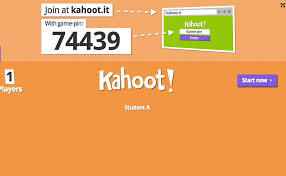
Kahoot is by far my most favorite web site and formative assessment tool.  Kahoot has been around for a while, but many clinicians have not heard of it, and its implications for increasing SEL.  Kahoot is extremely fun, informational and engaging.  So what is Kahoot?  Kahoot is a tool that can be used for a variety of purposes, assessing students, collecting data, checking for understanding and having fun.  Kahoot is free, easy to set up, and can be used  with any device (cell phone, Ipad, Android tablet, laptop or computer).  One important note, you should have a large screen available (like in the picture above), to display/project the questions on.  The participants need to see the questions all at one time to participate in a Kahoot.

 I have introduced Kahoot to kindergarteners and they were able to pick up the concept easily.  Kahoot gives the instructor the ability to restrict people from entering a name on the board that is offensive or inappropriate.  The instructor can just cross off the name on the board and it will disappear.  Some students may struggle with the coordination of looking at the screen and matching the correct answer to the color on their screen, but with practice, these students catch on wonderfully.  Kahoot also can promote collaboration as students can play as a team, or assist each other.  It is a great social emotional learning tool. 

Here’s what the Kahoot site shares about this phenomenal tool

CREATE

Through a simple ‘drag & drop’ creator tool (using any device), build quizzes with embedded imagery and video, based on educational content. Or, find public content to play.

It’s fast, intuitive and fun!  

Image result for kahoot

LAUNCH

Engage the room and focus attention by projecting the quiz onto the screen at the front. Without needing an account, everyone in the room quickly joins through their personal device, seeing their name appear at the front.

Join using any device with a web browser!
kahoot2

PLAY

Answering questions in real time through an easy-to-use interface, they play against each other aiming to top the on-screen leaderboard, whilst you facilitate and discuss the content.

Formatively assess individual knowledge and adapt learning to suit!

kahoot3

Here is a short video on how to make a Kahoot.

 https://youtu.be/pFFv6_6was4

I have used Kahoot for many social emotional learning lessons.  I use it for review with social skills books such as learning about differences, or tattling.  I reinforce a skill that was taught in one of their classes, and promote collaboration skills.   The best part is, you can use the data to show learning outcomes.  Kahoot is really a great way  to get your students involved.  Leave a comment on how you would use Kahoot in your clinical practice.  Have Fun!

Here is a Kahoot for social emotional learning.  https://play.kahoot.it/#/k/2514d6a5-daea-4011-b97a-6be8e95bb03a
Announcing the Try-a-Tool-a-Week Challenge!

Okay, so you’ve been wanting to try out more of the awesome free web apps you know are out there, but you just haven’t got around to it. Well, here’s your chance to get started an easy, fun way!  Sign up and watch the engaging videos and learn how to use the highlighted tools.  There are plenty ways to use these tools while working with students in a therapeutic setting.  By now the challenge is up to week five, but you can still try and explore all of the tools presented earlier.  Let your voice be heard and tell them you are a clinician using technology, in a feedback post.  This is a wonderful opportunity to learn new techniques.  Drop me a comment and tell me what you think about the tools and how you would use them in lessons and counseling.    Have fun! 

Tool-A-Week

via Announcing the Try-a-Tool-a-Week Challenge!.

Here is the example of week #2 challenge  


Celebrate School Social Work Week

PUTTING SOCIAL EMOTIONAL LEARNING IN COMPUTER CODING

SEL & CODING

There has been a lot of talk about introducing computer science to elementary students and adding it as a course in schools.  An even bigger buzz word is CODING.  So what is coding?  I’m going to tell you in my own simple terms.  Coding is the term used for instructing a computer what to do.  You can use word, symbols and numbers to tell the computer to go left, right, backwards, forwards, move 10 spaces or 20 and do the same thing all over again, and then even more can be done.  I think you get the picture.  I don’t have a degree in computer science or technology, but one thing is for sure, I love working with the software that is made for computers.  I have tried the coding tools and free tutorials and I can say they are very fun.  There has been a lot of emphasis placed on getting students to begin exploring coding, especially girls and specifically minorities.  Teaching and assisting my students to code has been pretty amazing as I see a lot of social benefits when working with them.  

You possibly by now have heard of Black Girls Code, Their mission is “to increase the number of women of color in the digital space by empowering girls of color ages 7 to 17 to become innovators in STEM fields, leaders in their communities, and builders of their own futures through exposure to computer science and technology. ”  There is also Girls who code.  They are “a national nonprofit organization working to close the gender gap in the technology and engineering sectors. With support from public and private partners, Girls Who Code works to educate, inspire, and equip high school girls with the skills and resources to pursue opportunities in computing fields.”

One of my all time favorites is home-grown Emile Cambry Jr. (his mom is a colleague of mine) who is the founder of Blue 1647, located in the Pilsen area in Chicago.  This young guy is making a huge difference in economic development in technology.  He holds a number of classes all geared toward assisting teens to learn about coding, making apps, video games and learning to love computer science.  Check out their site Blue 1647.  The next sites are opening in the Englewood and North Kenwood communities.  I am planning to volunteer some time to Emile’s group.

So this brings me to my title, the social emotional learning in coding.  How can a social worker/clinician, that loves computer engagement, use coding to counsel and teach students.  Well I found a wonderful , fun and engaging way to not only teach my students coding, but conduct formative assessments, while teaching social skills.  I found a great tool called Beebot.  Beebot is a small programmable robot that holds at least 40 commands and travels in 6″ steps and 90 degree turns.  I have a grid that is pre made, that I use with my Beebot to complement my lessons.

I have chosen to do bibliotherapy readings with my students from a variety of social emotional books.  Some of my favorites are by Julia Cook (Tattle Tongue) and the Howard B. Wigglebotttom series.  I have enclosed a short video of how we use Beebot.  The students (who have had some exposure to basic coding) love to use logic and directional skills to program Beebot to the correct answer.  I’ve also used Beebot with numbers and other picture prompts.  There are loads of sites a clinician can use to introduce coding to students.  You’ll  get students to: collaborate, use decision-making skills, take turns, learn directional skills, control emotions and many other social emotional skills with coding.  See Beebot in action below

Click here:  http://www.teachertube.com/embed/video/372368

Jcook books

Julia Cook Books


Social Emotional Learning in Coding – TeacherTube

Social Emotional Learning in Coding – TeacherTube.

Control Your Identity on Social Media, or Someone Else Will

With the new year just in, I couldn’t help but share this informative slideshare made by Susan M. Bearden, about managing your online identity.  This information is so important for all to be aware of, especially our students, who know no other way than getting acquainted through social media.  You can get other great information from following Susan on twitter @s_bearden.  

This is funny but so true.  Have you ever been in a scenario where there is a group of people all interacting and sharing.  The teens in the group seem to not interact with each other, or so you think.  This is where social media comes into play.  All it takes is a small conversation consisting of, “are you on instagram, and what’s your snapchat name,” and its all done.  Your teens/young adults get social, often in the same room, while the party is going on, on separate sides of the room, and it continues after they’ve left.  You wonder and ask, “when did you meet that person, and how do you know so much about them?”  The answer, SOCIAL MEDIA!  

Check out your digital footprint, and see what you find out.

In what ways has social media affected you or someone else?  Leave a reply and share your thoughts.

More advice from the folks at Flocabulary- Post safely!

http://www.youtube.com/watch?v=I47ltgfkkik

Have a happy new year!

image

Thanks to all my subscibers and those who just stop in and read my posts. You guys are an inspiration, and my motivation for writing. I hope you continue to enjoy my blog.
Do more with tecnology this year. Question: What new tech tools will you try?

Counselor’s Corner: Pinterest-Inspired Winter Art and Activities for Back-to-School

Wonderful article from one of my favorite go to blogs.

Girls Who Code Expands To Get More Young Women In Computer Science Majors

I hope to see this program in Chicago.

Chicago Toy and Game Show #ChiTag: Great Finds For Tech And Games That Enhance SEL

ChiTag Event

ChiTag Event

One of the events that I like to attend is the Chicago Toy and Game Show, that usually is held in November at Chicago’s Navy Pier.  This show is a great place to find innovative and different toys, games and technology that can be used with students for counseling.  This event is fabulous, and once many of the venders find out you work for a school or an organization that assists students, they often will give you a discount, freebies, or even  offer you a samples of their games or items.  You can meet the inventors of the games, and see the games and toys tried out by people at the events.  This is how I could envision many of the therapeutic effects of the games.  If you haven’t gone to an event such as this, and you love toys, tech and games, you shouldn’t miss this event next year.  

Life size operation game

Life size operation game

Above is the inventor of the game, Operation.

Great game for SEL

Great game for SEL

I love this game, as it is like the old game you played with your friends “Concentration”, without a board.  You get a category and think up words within that category, and you are eliminated when you can’t guess a word.  The twist in Tapple is, you have to find words that begin with a certain alphabet and each letter is tapped out until only a few letters are left and you have to guess a word in that category that starts with one of the remaining letters.  

A variation of the game could be teaching the students emotion words and having them use the Tapple tool to tap out the various emotions that begin with different letters.  This addresses Common Core Standards and you have so much fun!  Go to the Tapple game site USAOPOLY to see a description of Tapple and another game that I find promising, SELFIE (and yes, it relates to selfies taken with a cell phone and how you appear to others, no cell phone needed).